Quantum Security|August 6, 2026
PQC vs. QKD: What Is the Difference?
PQC and QKD address quantum-era security at different layers. They are complementary approaches, not interchangeable answers.
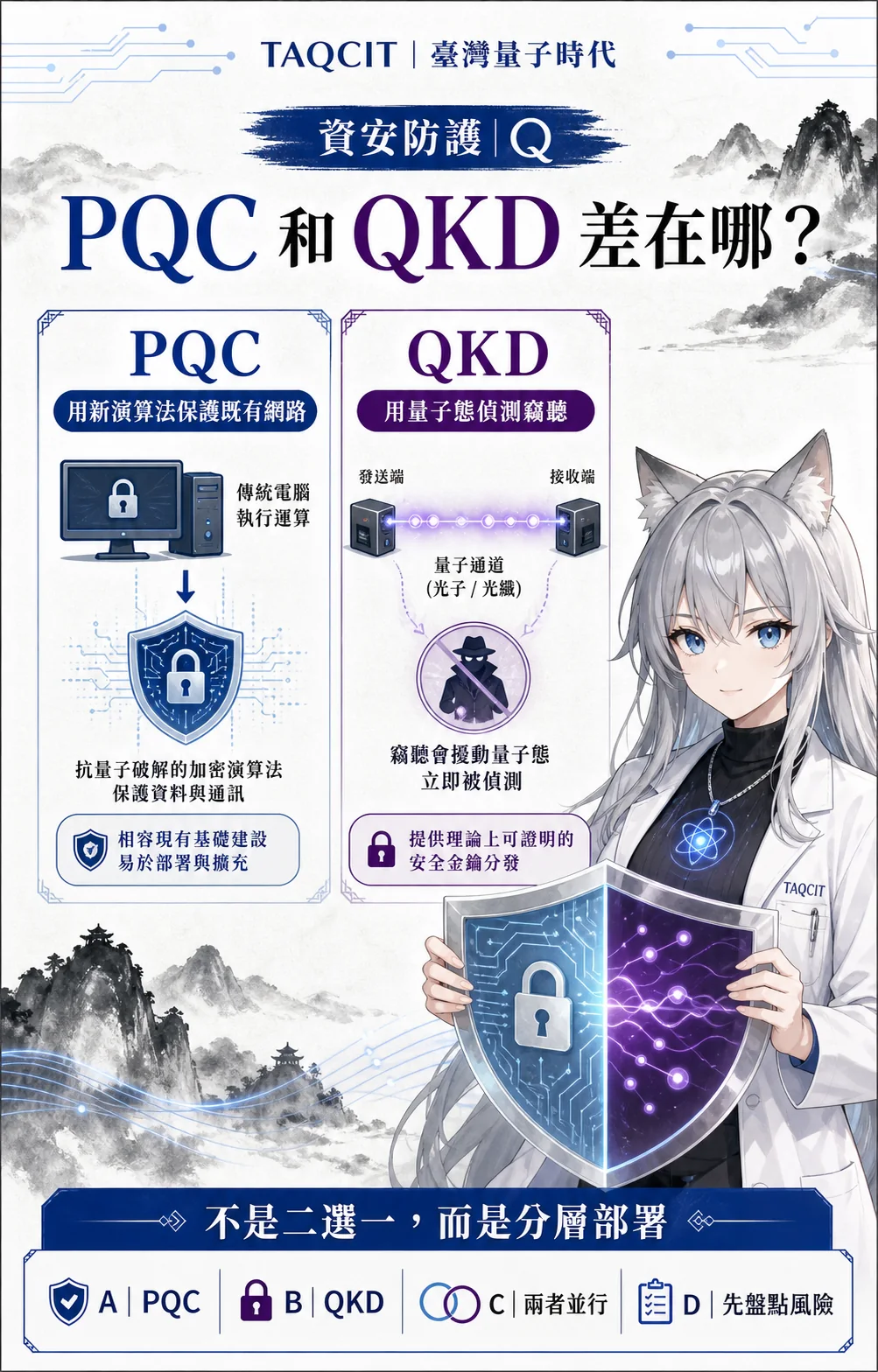
PQC changes algorithms—not the entire network
Post-quantum cryptography (PQC) uses mathematical problems currently believed to resist quantum attacks to build new key-establishment and digital-signature schemes. Because it runs on conventional computers and networks, organizations can introduce it gradually across software, certificates, servers, and endpoints.
The difficult part is often not selecting one algorithm. It is discovering where quantum-vulnerable public-key cryptography remains in use and building cryptographic agility so algorithms can be replaced over time.
QKD distributes keys through quantum states
Quantum key distribution (QKD) uses quantum properties of light to establish shared keys. In an ideal protocol, measurements made by an eavesdropper alter the statistics and can reveal an anomaly.
QKD still requires optical equipment, quantum and classical channels, and authentication. It also faces limits in distance, cost, and implementation security. It addresses key distribution—not every encryption, endpoint-security, or access-control problem.
They protect different parts of the system
PQC can be integrated into existing digital infrastructure. QKD may add a layer of protection to selected high-value links through different physical principles. The practical question is not simply which one wins, but which systems should migrate to PQC first, which links justify evaluating QKD, and whether key management, authentication, and endpoint security are being addressed together.
Start by identifying what must be protected
Inventory data-retention periods, public-key algorithms, equipment life cycles, and upgrade paths before setting priorities. For most organizations, cryptographic inventory, cryptographic agility, and PQC migration are immediate tasks. QKD should be assessed against the risks, operating environment, and available infrastructure.
Continue exploring technology and ideas for the quantum era