Quantum Industry|August 17, 2026
From Wafer Processing to Quantum Systems: Where Can Taiwan Join the Next Value Chain?
Quantum computing is more than a laboratory race for qubit count. It depends on fabrication, packaging, control, and an entire industrial supply chain.
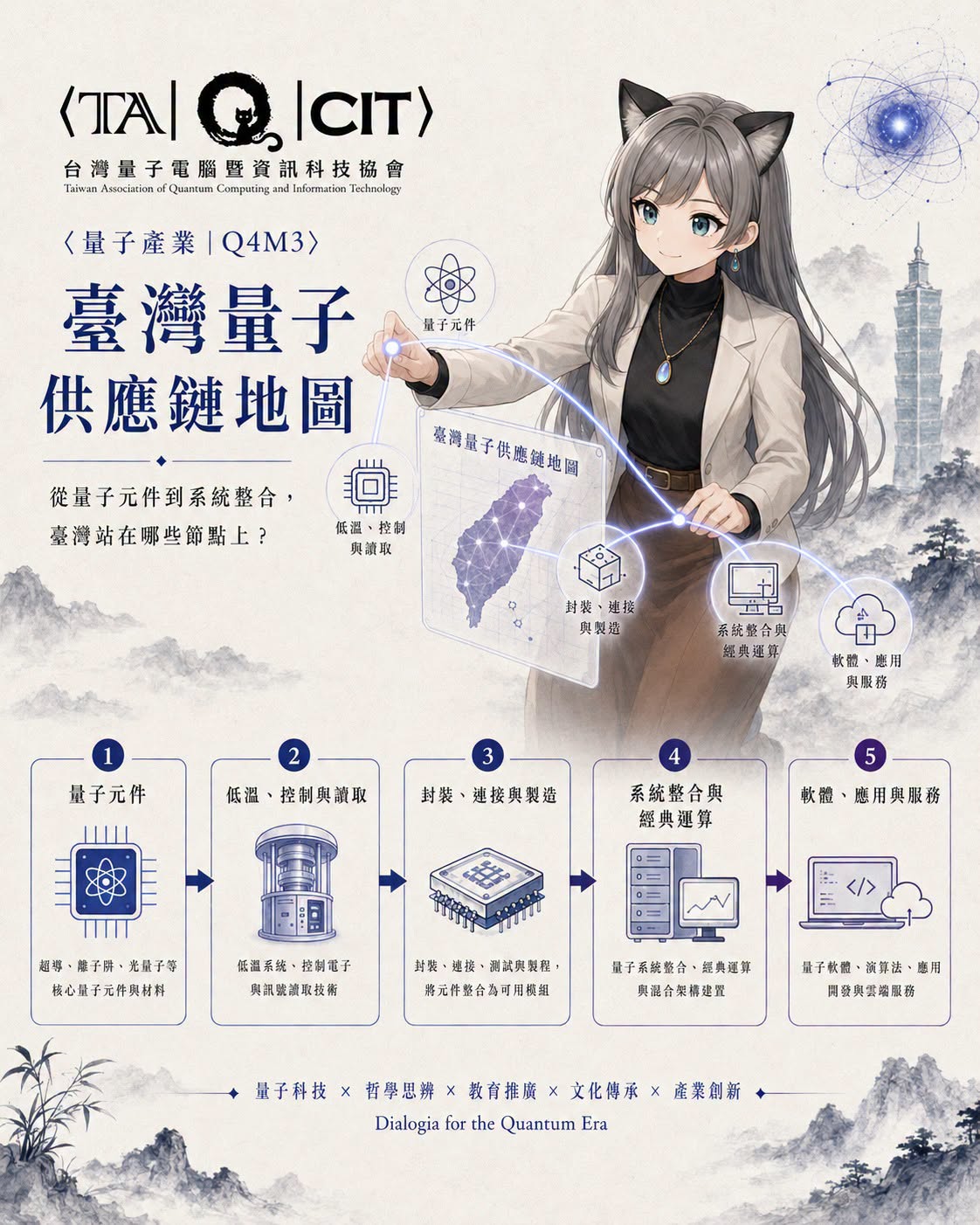
A quantum computer is more than its qubits
A working quantum computer combines quantum chips, cryogenic systems, control electronics, signal chains, packaging, calibration, software, and applications. Comparing qubit counts alone obscures the engineering and manufacturing capabilities required.
The practical question is not whether Taiwan must immediately build every part of a quantum computer. It is where Taiwan already sits in the supply chain, and which capabilities can be adapted to the precision, temperature, noise, and reliability requirements of quantum systems.
Semiconductors are close—but not a direct copy
Quantum systems require chip design, fabrication, packaging, testing, and control electronics—areas in which Taiwan has accumulated deep industrial capacity. Taiwan's advanced semiconductor R&D plans also include silicon photonics and forward-looking quantum technology.
A quantum chip is not simply a conventional CMOS flow repeated at lower temperature. Qubit modalities impose different requirements for materials, noise, cryogenic behavior, and process uniformity. The transferable advantage lies in design, manufacturing, packaging, testing, and rapid iteration.
Cryogenic electronics and precision interconnects
Superconducting processors operate at extremely low temperatures while much of the control equipment remains warmer. Large numbers of signals must cross temperature stages. Cables, connectors, control chips, and readout electronics can become scaling bottlenecks if they introduce too much heat or noise.
ITRI has developed control chips and modules that operate at 4 K. Taiwan's Quantum Industry Technology Promotion Office has likewise identified cryogenic-to-room-temperature interconnects, control chips, components, and system integration as potential entry points into the global supply chain.
Photonics and silicon photonics share capabilities
Photons are important carriers of quantum information. Quantum communications, light sources, readout, and chip-level optical integration all require precision photonics. Some of Taiwan's capabilities in silicon photonics, photonic integrated circuits, coupling, packaging, and measurement may extend into quantum photonics.
Silicon photonics is not the same as quantum photonics. Their relationship lies in shared engineering capabilities. Identifying which processes and measurement techniques transfer is more useful than equating two popular fields.
ICT and system integration reconnect quantum with the classical world
Quantum processors must work with control computers, data centers, high-performance computing, networks, and software. Taiwan's strengths in servers, networking, embedded systems, and electronics manufacturing could take on new roles as hybrid quantum-classical architectures mature.
The business models remain in formation, so these are potential extensions rather than mature markets. A real supply chain must still solve interface, validation, compatibility, reliability, and volume-manufacturing questions.
The Q4M3 perspective
Q4M3 asks how technology reaches Market, Makers, and Money: who can manufacture it, who will adopt it, how capital should evaluate it, and what position Taiwan can occupy in the global value chain.
The quantum industry may not grow as an entirely separate supply chain. It may emerge as new branches on Taiwan's existing industrial strengths in semiconductors, cryogenic electronics, photonics, precision manufacturing, and ICT—adapted to quantum-system requirements.
Continue exploring technology and ideas for the quantum era