Quantum Industry|August 24, 2026
HPC → AI → QPU: A New Workflow for Quantum Chemistry
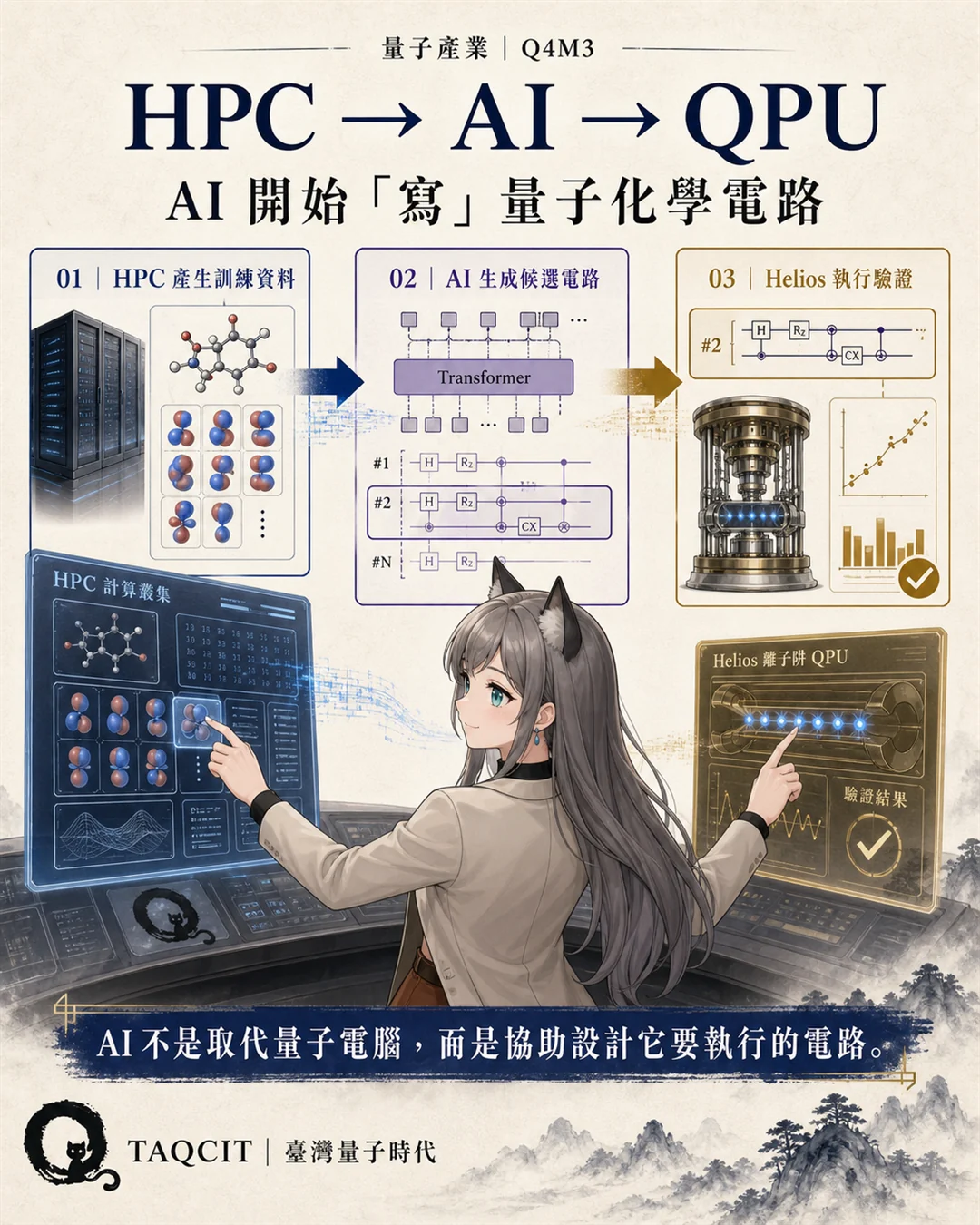
HPC produces and processes data, AI proposes candidate circuits, and a QPU performs state preparation and measurement. The key question is whether the three can form a verifiable hybrid workflow.
AI learns circuit structure—it does not simply output the answer
Conventional VQE and ADAPT-VQE repeatedly select a circuit structure, calculate energy, and update parameters. As molecular systems and operator pools grow, finding a useful circuit can itself become expensive.
ADAPT-GQE represents quantum gates and operators as token-like sequences so a transformer can learn arrangements that may prepare a state near a molecular ground state. The model proposes candidate circuits, but energy calculations and physical constraints still screen them. AI acts more like a circuit designer than a machine that produces a proven answer.
The workflow joins HPC, AI, and a QPU
The research presents a hybrid pipeline: HPC accelerates data generation and simulation, AI learns circuit sequences from that data, and selected circuits are then executed on a QPU.
The team studied conformations of the drug molecule imipramine in 12–16-qubit active spaces and sent generated circuits to Quantinuum's Helios-1 for execution and validation. The three layers do different jobs rather than replace one another: HPC builds and processes data, AI proposes structures, and the QPU performs quantum-state preparation and measurement.
This remains a proof of principle
The result suggests that generative models may reduce repeated circuit-search costs, but it does not establish commercial quantum advantage. The active spaces in the study remain accessible to classical analysis, and the model relies on existing ADAPT-VQE results as training data.
The harder tests will come when classical simulation becomes difficult: whether the model generalizes, whether candidate circuits remain accurate, and whether hardware noise erases the savings achieved in circuit design.
Quantum-software value may emerge in the workflow
If this direction matures, quantum-chemistry software will be more than an interface that sends a problem to a QPU. It must coordinate data generation, model training, circuit selection, resource estimation, hardware compilation, and result validation.
Industry assessment should therefore ask more than whether one model can produce an elegant circuit. The complete workflow must consistently identify which task belongs to AI, which stage needs HPC, and when a QPU is justified.
How to read the result
This article separates the research paper, the company's technical account, and TAQCIT's industry interpretation. The research demonstrates a proof-of-principle generative quantum-AI workflow. The view that value may arise from workflow integration is an editorial inference, not a market outcome proven by the study.
Continue exploring technology and ideas for the quantum era